
We’ve all heard it before: eat more whole foods, cut back on the processed stuff, stay hydrated, get enough sleep, and repeat. It’s the wellness world’s version of “back up your files”—basic, maybe, but foundational.
But now, a groundbreaking 30-year study published in Nature Medicine has confirmed what many of us have long believed: how we nourish ourselves in our 40s, 50s, and 60s directly impacts how we show up in our 70s—and beyond. And this time, there are numbers to prove it.
It’s Not Just About Avoiding Illness—It’s About Thriving
This study tracked over 100,000 adults for three decades, measuring how closely they followed one of eight dietary patterns. Researchers weren’t just looking for disease prevention; they defined “healthy aging” as reaching 70+ without major chronic disease, with strong physical and cognitive function and stable mental health (Zhong et al., 2024).
Only 9.3% of participants hit all of those markers—but the people who did had one key habit in common: consistent, long-term healthy eating, especially during midlife.
One dietary pattern stood out: the Alternative Healthy Eating Index (AHEI)—a balanced, plant-forward way of eating that includes fruits, vegetables, whole grains, healthy fats, legumes, nuts, and moderate amounts of fish and dairy.
Here’s the striking part: those who followed the AHEI closely were 86% more likely to reach age 70 in good health—and more than twice as likely to still be thriving at 75 (Zhong et al., 2024).
“It’s not only about living longer, but being able to live longer with better health,” says Dr. Marta Guasch-Ferré, co-author and associate professor at the University of Copenhagen. “We’re talking about maintaining independence—not just physically, but emotionally and cognitively” (Nature Medicine, 2024).
Yes, You’ve Heard This Before—But This Time With Long-Term Data
Most of the information is familiar, but the scale and specificity of this research make it hard to ignore. This isn’t about short-term studies or trendy diets—it’s real-world, long-term evidence showing how the choices we make in our kitchens today shape our resilience decades from now.
-
Ultra-processed foods? Still best to avoid.
-
Sugary drinks? A pass.
-
Whole fruits, veggies, whole grains, nuts, legumes? Always a yes.
-
Fresh Fish and chicken? Absolutely.
-
Red meat and salty processed foods? Keep it minimal.
And maybe most encouraging of all: it’s not about being perfect. What matters is your overall pattern—how you eat most of the time.
Six Everyday Foods That Support Longevity
This research reinforces what I already try to live and teach: that nutrition isn’t about restriction—it’s about intention. Here’s a simple breakdown of the AHEI-inspired eating pattern that really does make a difference:
-
Vegetables Aim for three servings a day, especially leafy greens like kale, spinach, or arugula. (Fries and white potatoes don’t count.)
-
Fruit Four servings of whole fruit daily is linked to lower risks of heart disease and cancer. Skip the juice—eat it whole.
-
Whole Grains Four servings of oats, brown rice, quinoa, or barley help protect against diabetes, heart disease, and even colorectal cancer.
-
Nuts, Legumes & Plant Proteins One serving daily of lentils, chickpeas, beans, or nuts offers fiber, protein, and metabolic benefits. Think of them as the main event, not the side dish.
-
Fish On serving of fatty fish like salmon or sardines, rich in omega-3s, can lower cardiovascular risk and support brain health.
-
Healthy Fats Choose unsaturated fats—olive oil, avocado oil—over saturated ones. Olive oil is great raw; avocado oil is perfect for cooking.
No Trends Required—Just Consistency
There’s no single perfect diet. But there is a pattern that works: eat real food, mostly plants, not too much (Pollan, 2008). The key is finding something sustainable and staying consistent—especially during those pivotal midlife years.
A Comforting Recipe to Get You Started
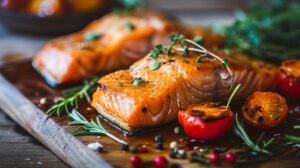
If you’re ready to make a small shift today, try this cozy recipe for Herb Roasted Salmon with Blistered Cherry Tomatoes—This vibrant dish pairs rich, tender salmon with sweet, caramelized cherry tomatoes and fresh herbs for a burst of flavor in every bite. Packed with omega-3s, antioxidants, and heart-healthy fats, it’s as good for your body as it is for your taste buds. Simple, clean, and ready in under 30 minutes — it’s the perfect balance of delicious and nutritious.
References:
- Zhong, V. W., Guasch-Ferré, M., et al. (2024). Association of midlife dietary patterns with healthy aging: a 30-year prospective cohort study. Nature Medicine. https://doi.org/10.1038/s41591-024-02805-5
- Pollan, M. (2008). In Defense of Food: An Eater’s Manifesto. Penguin Press.
- Department of Nutrition, Harvard T.H. Chan School of Public Health, Boston, MA, USA Anne-Julie Tessier, Fenglei Wang, A. Heather Eliassen, Jorge Chavarro, Jun Li, Walter C. Willett, Qi Sun, Meir J. Stampfer, Frank B. Hu & Marta Guasch-Ferré
- Superage Article The Best Foods for Healthy Longevity
 Hi there! I’m Christine, the heart and hands behind Christine Crawford Health. I’m passionate about sharing tips, recipes, and insights to help you nurture your mind, body, and soul. Like everything on my site, this article comes from my personal journey and my love for helping others find balance and joy. If you’d like to connect or learn more, feel free to email me at christinecrawfordhealth@gmail.com Thank you for being part of this journey with me!